Where will the thunderstorm hit, how hard, and when?
That’s the question I work on at MeteoSwiss, Switzerland’s Federal Office of Meteorology and Climatology, in Locarno. In the Development of Forecasting department, I am the scientific project lead of COALITION, MeteoSwiss’ AI-based thunderstorm nowcasting system. It predicts the intensity, location and development of thunderstorms, and the hazards they bring, over the next hour.
Our project team has successfully turned research into operations. The current generation, COALITION-4, is a probabilistic deep learning model that fuses radar, lightning and topography data. Since 2025, its products have been available on the forecasters’ screens, and since 2026 its automatic warning suggestions have been part of the operational warning chain: forecasters refine them, and the combined, high-quality warnings power the MeteoSwiss App and reach the public, civil protection and other authorities. Across their generations, the COALITION models bring together satellite meteorology, thunderstorm nowcasting and AI.
What drives me
- Nowcasting convection, thunderstorms, rain, hail and wind gusts
- Deep learning for weather prediction and early warnings
- Reading clouds, aerosols, trace gases and precipitation from space
- Radiative transfer in the Earth’s atmosphere
- Leading projects and teams
How I got here
My scientific career started in the Arctic and in the tropics. During my meteorology studies in Hannover, I spent a year at the University Centre in Svalbard at 78°N, taking measurements on sea ice and in the pack ice off Greenland. For my diploma thesis I developed a Monte Carlo radiative transfer model, and for my PhD at the German Aerospace Center (DLR) I calculated how radiation heats the tropical tropopause, the gateway through which air enters the stratosphere. Along the way I helped develop libRadtran, one of the most widely used open-source radiative transfer packages.
From 2010 to 2013, as a EUMETSAT fellow at the Royal Netherlands Meteorological Institute (KNMI), I turned to cloud remote sensing from satellites. I co-coordinated the Cloud Retrieval Evaluation Workshop (CREW), which compared the satellite cloud retrievals of 12 institutes in Europe and the USA, at the time the largest comparison of its kind, and led the evaluation of ten cloud top height algorithms. CREW has since become the International Clouds Working Group of CGMS. In December 2013, I brought this satellite expertise to MeteoSwiss in Locarno and turned it towards thunderstorm nowcasting.
Projects
Projects I have worked on, most recent first.
Varda: AI weather forecasting at MeteoSwiss
MeteoSwiss, since 2026, contributor
Varda is MeteoSwiss' data-driven weather prediction system and the planned successor of the INCA nowcasting system. Its first version, Varda-single-1.0, provides hourly deterministic forecasts on a 1 km mesh over the Alpine region, using stretched-grid graph transformer models built in the open-source Anemoi framework and fine-tuned with high-resolution ICON data. Temporal interpolators refine the forecasts to hourly and 10-minute intervals, closing the gap between nowcasting and short-range forecasting.
I contribute to the design and planning of the use of satellite data and of thunderstorm nowcasting in Varda. I am lead author of a successful proposal for a three-year EUMETSAT fellowship on bringing Meteosat Third Generation observations into Varda and assisted in another proposal. I am one of many co-authors of the first Varda paper.
Pennino, A., et al. (2026). Varda-single-1.0: deterministic data-driven weather forecasting at 1 km resolution over Switzerland's complex topography. arXiv:2610.01835.
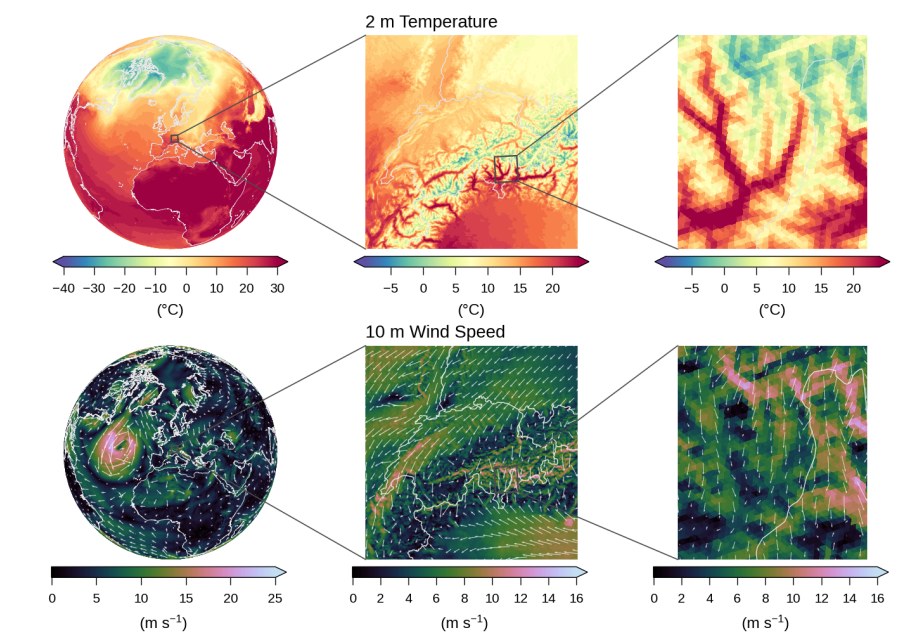
COALITION-4: thunderstorm forecasting with artificial intelligence
MeteoSwiss, scientific project lead, 2020–2026
COALITION-4 predicts thunderstorm hazards such as lightning, hail and heavy precipitation for the next 60 minutes. Its deep learning model, an encoder–forecaster network with recurrent convolutional layers, fuses radar, lightning and topography data into probabilistic nowcasts at 1 km and 5-minute resolution over Switzerland. Research versions additionally used NWP data, satellite observations and dual-polarisation radar observations. COALITION-4 runs operationally in the cloud since 2025 and, since summer 2026, produces automatic thunderstorm warning suggestions for the MeteoSwiss App, civil protection and the Joint Information Platform for Natural Hazards (GIN), improving skill over the previous system across all hazards and lead times.
The model was developed by the EUMETSAT fellow Jussi Leinonen, whose fellowship I initiated and supervised. Apart from the scientific lead, I also co-led the modernisation and migration of COALITION-4 to the cloud with a team of research scientists and cloud experts, including event-driven processing, monitoring, refactoring, adaptation to cloud technologies and more robust operations such as fallback modes. I set up the product delivery to the visualisation platform NinJo and to the MeteoSwiss App, trained the forecasters, and calibrated the warning procedures together with them according to their requirements. I co-supervised further developments for hail nowcasting and the exploitation of polarimetric radar by Nathalie Rombeek and refined training strategies by George Pacey, and presented COALITION-4 in invited talks and keynotes.
Project page at MeteoSwiss · Source code (research version) on GitHub
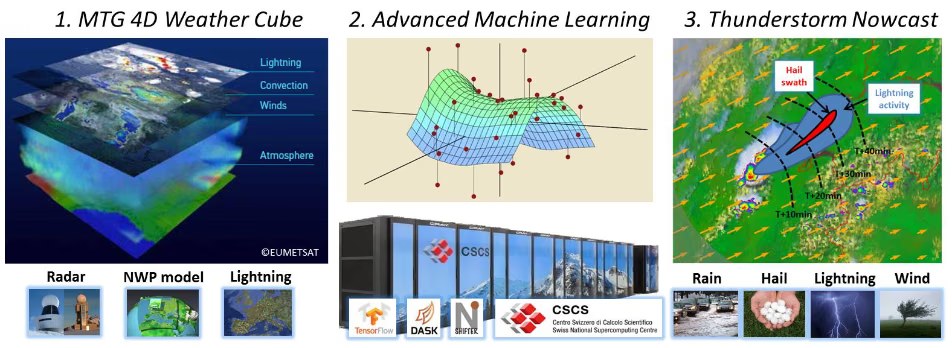
COALITION-3: machine learning prediction of thunderstorm severity
MeteoSwiss, scientific project lead, May 2018 – December 2023
COALITION-3 predicts the severity of existing thunderstorm cells for the next 45 minutes. It combines conceptual models of thunderstorm evolution with machine learning and a large set of predictors from MeteoSwiss' dual-polarisation radar network, MSG/SEVIRI infrared channels, Nowcasting SAF products, lightning and NWP data. Trained on a large archive of thunderstorm life cycles with known development, it forecasts the evolution of each cell along the MeteoSwiss warning levels and provides forecasters with automated warning suggestions.
I designed and planned the project. Together with my interns Joel Zeder (automatic warnings), Shruti Nath (optimisation and uncertainty) and Livia Näf (atmospheric instability), I carried out the practical work, from the curation and analysis of the thunderstorm archive to the training and verification of the machine learning models. As for the other COALITION systems, we presented the results to the forecasters and trained them in the use of the new product. The experience gained in COALITION-3 laid the foundation for the EUMETSAT fellowship proposal that led to COALITION-4.
COALITION-2: satellite-based detection of developing thunderstorms
MeteoSwiss, scientific project lead, 2014–2022
COALITION-2 detects developing thunderstorms from satellite observations. In the early stages of a thunderstorm, intensifying convection is already visible from space as rising and glaciating cloud tops, before precipitation-sized hydrometeors form that a weather radar can detect. Using MSG/SEVIRI infrared channels in rapid-scan mode (5-minute updates), Nowcasting SAF cloud products and wind fields from the COSMO-CH model, COALITION-2 gives early indicators of thunderstorm development, typically 5 to 10 minutes before the radar, and also works beyond the range of the Swiss radar network.
As scientific project lead, I brought COALITION-2 into operations: the product was delivered to the forecasters' visualisation platform NinJo, where it served as an additional source of information for their decisions on thunderstorm warnings, complementing the radar-based cell tracking TRT. Together with my intern Elena Leonarduzzi, I improved the estimation of cloud motion for the tracking of convective cells. I presented the results at EUMETSAT conferences, the European Conference on Severe Storms and the EGU General Assembly.
CREW: Cloud Retrieval Evaluation Workshop
KNMI, 2010–2013, co-coordinator
As a EUMETSAT fellow at KNMI I investigated the status of the most advanced cloud remote sensing algorithms for passive imagers within the Cloud Retrieval Evaluation Workshop (CREW). I compared and validated the MSG/SEVIRI cloud retrieval algorithms of 12 major research institutes in Europe and the USA, at the time the largest inter-comparison of Level-2 cloud remote sensing algorithms.
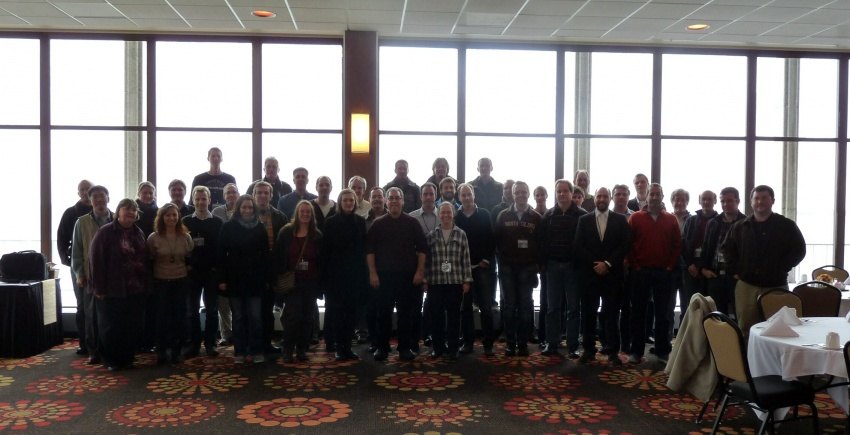
I administered and extended the CREW database, created the CREW project website and helped organise the meetings of the CREW community: CREW-3 in Madison, Wisconsin (USA) in November 2011 and CREW-4 in Grainau (Germany) in March 2014. CREW has since been endorsed as the International Clouds Working Group of the Coordination Group for Meteorological Satellites (CGMS).
PyTroll: open-source processing of satellite data
MeteoSwiss and open-source community, contributor
Pytroll is a free, modular, open-source Python framework for processing Earth observation satellite data, used for research and for 24/7 operational production at weather services. Its key packages include Satpy (reading, compositing and writing satellite data such as MSG/SEVIRI and MTG), Pyresample, Pyspectral and Pyorbital. Started in 2009 at the Danish and Swedish weather services, it has grown into a community of many European and international weather services, EUMETSAT and universities.
My colleagues and I introduced Pytroll at MeteoSwiss and used it to produce a suite of satellite products for the internal MeteoSwiss SatelliteLive website. I took part in the Pytroll developer workshops, contributed to the open-source code base, and co-authored the reference paper describing the framework in the Bulletin of the American Meteorological Society (2018).
libRadtran and PhD thesis on radiative heating in the tropical tropopause region
Leibniz University of Hannover and DLR Oberpfaffenhofen, 2003–2010
libRadtran is a widely used open-source software package for radiative transfer calculations in the Earth's atmosphere, computing radiances, irradiances and heating rates from the ultraviolet to the thermal infrared. During my PhD at DLR I used it to simulate the radiative heating rate in the tropical tropopause layer, the gateway through which air enters the stratosphere, based on ECMWF and other data sets (thesis).
For libRadtran, I implemented a flexible handling of the model input data, including the consistent vertical processing of trace gases, cloud liquid and ice water content, as well as spectrally resolved surface albedo. I also developed interfaces for using NWP data as input and a processing mode for simulating satellite images. As a postdoc at DLR, I implemented the ice cloud optical property parameterisation of the climate model ECHAM in libRadtran. I am co-author of the libRadtran reference paper (Emde et al., 2016) and the user's guide. My work on radiative transfer started even earlier, with my diploma thesis at Leibniz University of Hannover, in which I developed the Monte Carlo radiative transfer model PROMT.
Achievements
Highlights, invited and keynote talks, and recognitions.
- 2026
- COALITION-4 produces automatic thunderstorm warning suggestions for the MeteoSwiss AppDeep learning thunderstorm nowcasts feed the MeteoSwiss thunderstorm warning system. Combined with the forecasters’ input, the warnings are delivered to the MeteoSwiss App, civil protection and the Joint Information Platform for Natural Hazards (GIN).
- 2025
- COALITION-4 runs operationally in the Amazon CloudCloud migration completed: first convective season of COALITION-4 operational production in the Amazon cloud.
- Nov 2025
- Panel discussion on Meteosat Third GenerationPanellist in the Meteosat Third Generation panel discussion at the 12th European Conference on Severe Storms (ECSS 2025), Utrecht, Netherlands, November 2025.
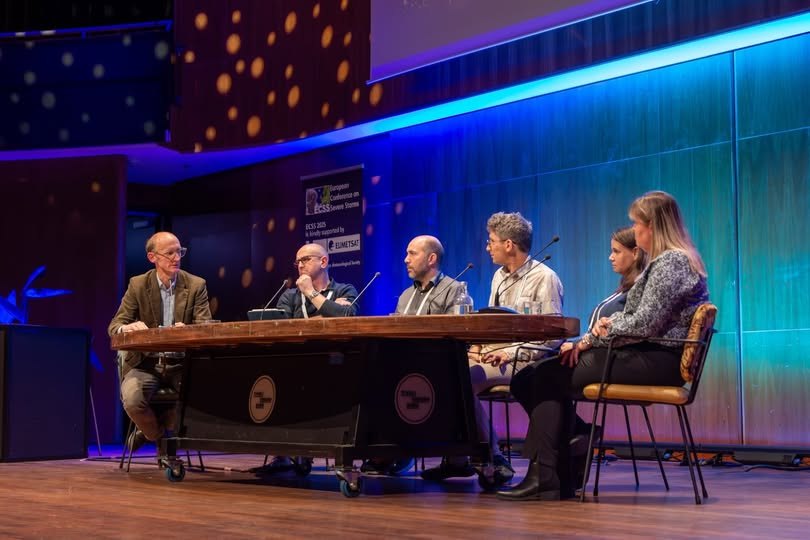
Meteosat Third Generation panel discussion at ECSS 2025, Utrecht. - Oct 2025
- Invited talk: A regional perspective on nowcasting from EuropeHamann, U., et al. Virtual WMO Workshop on Core Satellite Data for Nowcasting, online, 15–16 October 2025.
- Mar 2025
- Keynote lecture: Precipitation nowcasting: from Lagrangian models to advanced ML approachesHamann, U., I. Sideris, L. Foresti, D. Nerini, J. Leinonen, A. Ntoumos, and U. Germann. PrePEP 2025, Conference on Precipitation Processes – Estimation and Prediction, Bonn, Germany, 17–21 March 2025.
- Jan 2024
- Invited talk: The thunderstorm nowcasting algorithm COALITION-4 and the deep learning wind analysis of MeteoSwissHamann, U., J. Leinonen, F. Zanetta, D. Nerini, M. Buzzi, N. Rombeek, P. Juda, and U. Germann. EUMETSAT Integrated Nowcasting Tools Workshop, Darmstadt, Germany, 23–25 January 2024.
- Apr 2023
- Solicited talk (co-author): Latent diffusion models for generative nowcasting and uncertainty quantification of precipitation fieldsLeinonen, J., U. Hamann, and U. Germann. EGU General Assembly 2023, Vienna, Austria, 24–28 April 2023, EGU23-9531.
- Apr 2023
- Solicited talk (co-author): Predictive hazards from convective systems with deep learningLeinonen, J., U. Hamann, I. Sideris, and U. Germann. EGU General Assembly 2023, Vienna, Austria, 24–28 April 2023, EGU23-9488.
- Mar 2022
- Keynote lecture (co-author): Seamlessly nowcasting lightning with convolutional-recurrent deep learningLeinonen, J., and U. Hamann. European Nowcasting Conference 2022, online, 21–25 March 2022.
- Nov 2019
- Invited presentation: Synergetic use of MTG FCI and LI for thunderstorm nowcastingHamann, U., J. Zeder, S. Nath, L. Clementi, L. Foresti, A. Hering, J. R. Mecikalski, D. Nerini, L. Nisi, A. Rigazzi, O. Romppainen-Martius, M. Sassi, and U. Germann. EUMETSAT MTG / EPS-SG User Days, Darmstadt, Germany, 12–14 November 2019.
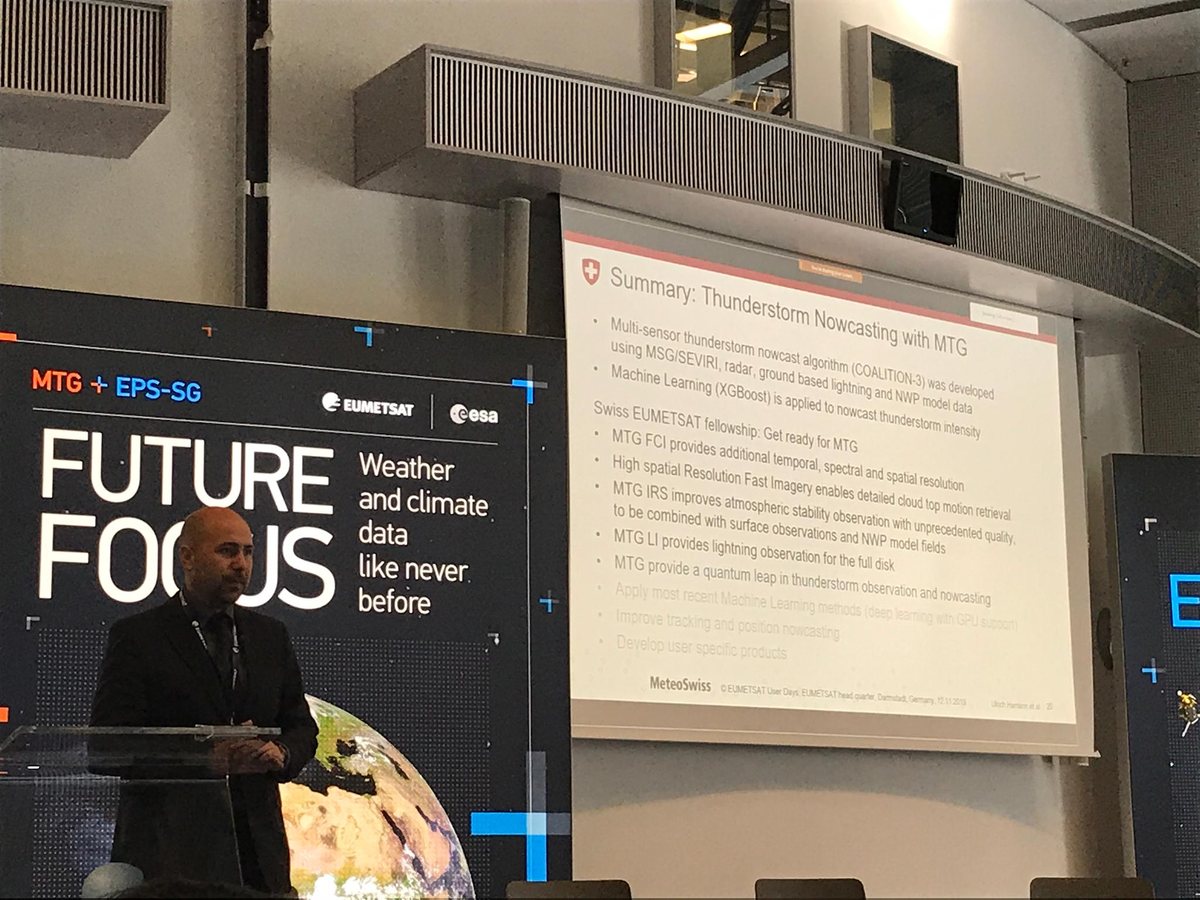
Presenting thunderstorm nowcasting with MTG at the EUMETSAT MTG + EPS-SG User Days, EUMETSAT headquarters, Darmstadt, 12 November 2019. - Nov 2019
- Best ECSS Poster Jury Award (co-author): Towards automated multi-sensor thunderstorm warning suggestionsNath, S., H. Barras, L. Clementi, L. Foresti, U. Hamann, A. Hering, D. Nerini, L. Nisi, M. Sassi, J. Zeder, and U. Germann. 10th European Conference on Severe Storms, Krakow, Poland, 2019.
- 2014
- CREW becomes a CGMS working groupThe Cloud Retrieval Evaluation Workshop (CREW), which I co-coordinated, was endorsed as the CGMS International Clouds Working Group. Under this mandate of the Coordination Group for Meteorological Satellites, the community of satellite operators and research institutes continues to evaluate and improve cloud retrievals from satellite observations worldwide.
- Aug 2002 – May 2003
- Studying abroad: one year in SvalbardArctic geophysics at UNIS, the University Centre in Svalbard in Longyearbyen, at 78°N: polar meteorology, oceanography, snow and ice, and the polar atmosphere, with fieldwork on sea ice and in Fram Strait. Read the full report with photos →
A Year in Svalbard
Studying abroad at UNIS, the University Centre in Svalbard, August 2002 – May 2003.
During our meteorology studies, Peer and I travelled to Svalbard, at the edge of the northern polar ice cap, for ten months. We lived in Longyearbyen, the main settlement of Svalbard, and attended lectures at UNIS, an outpost of the Norwegian universities. We took courses in Arctic geophysics, covering oceanography (air–ice–sea interaction), polar meteorology, the cryosphere (glaciers, snow, ice), the middle polar atmosphere (polar stratospheric clouds, noctilucent clouds, polar mesospheric summer echoes) and the upper polar atmosphere (aurora borealis).
One year in Svalbard
We had a very special experience when we decided, in August 2002, to study for ten months at the world's northernmost university, UNIS in Svalbard. Svalbard is an archipelago between the North Cape and the North Pole, stretching from 74°N to 81°N.
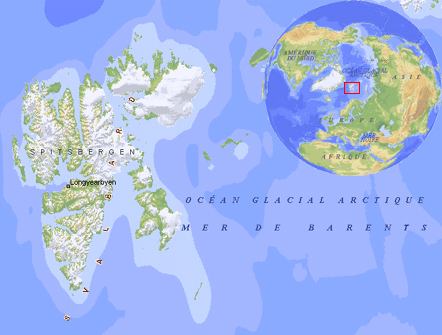
With the Svalbard Treaty coming into force in 1920, the archipelago came under the administration of the Kingdom of Norway, while citizens of every nation have the right to live and work there. Apart from a few research stations, however, there is only one Norwegian and one Russian settlement. The (human) population is about 2,800, of whom roughly 1,000 are Russian, plus about 2,000 polar bears and several thousand reindeer.
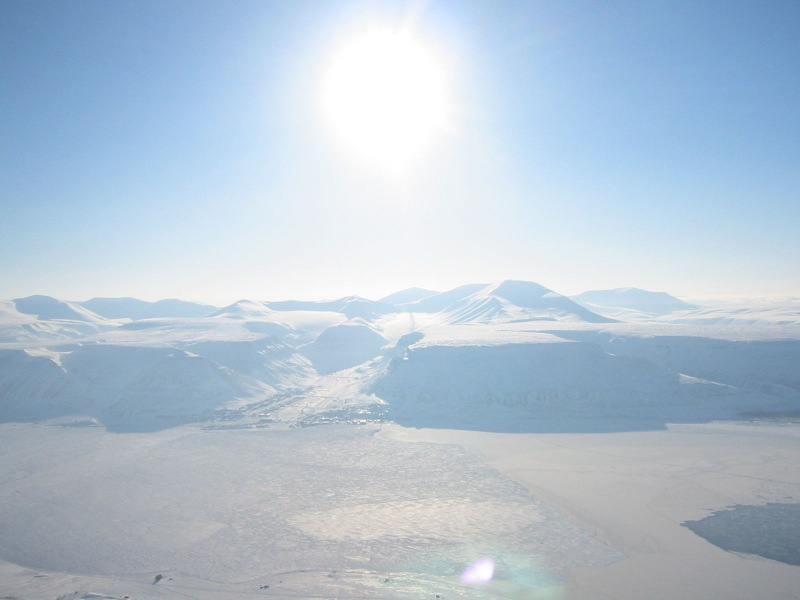
The Norwegian settlement of Longyearbyen, named after its founder John Munro Longyear, is home to UNIS (Universitetssenteret på Svalbard), an outpost of the four Norwegian universities. Although only about 1,700 people live in Longyearbyen, it offers all the comforts of civilisation, from a shopping centre, pubs and restaurants, a swimming pool and sports hall, a library and a cinema to an airport. Over the last century, Longyearbyen has turned from a mining settlement into a small, modern town.
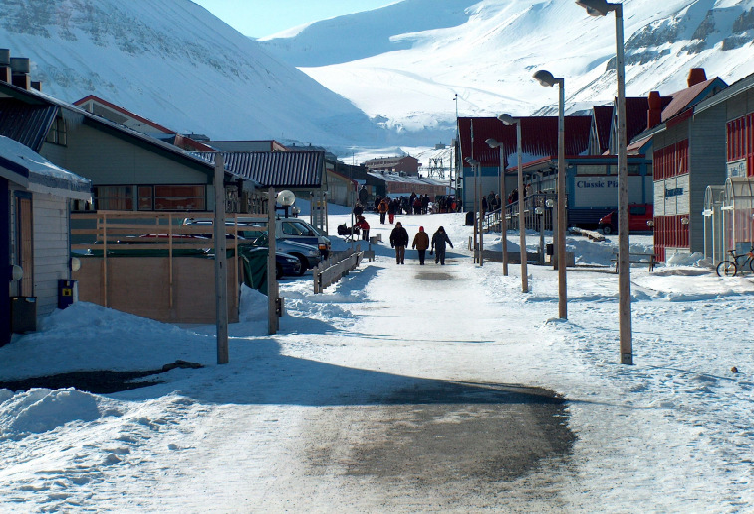
At the end of the Longyear valley, at the foot of two glaciers, lies the former miners' settlement of Nybyen, whose modernised houses (Norwegian: brakke, not to be confused with the German word "Baracke", barracks) serve as student accommodation. Nybyen is an ideal starting point for excursions into the surroundings, for example to Nordenskiöldfjellet, the more than 1,000 m high local mountain.
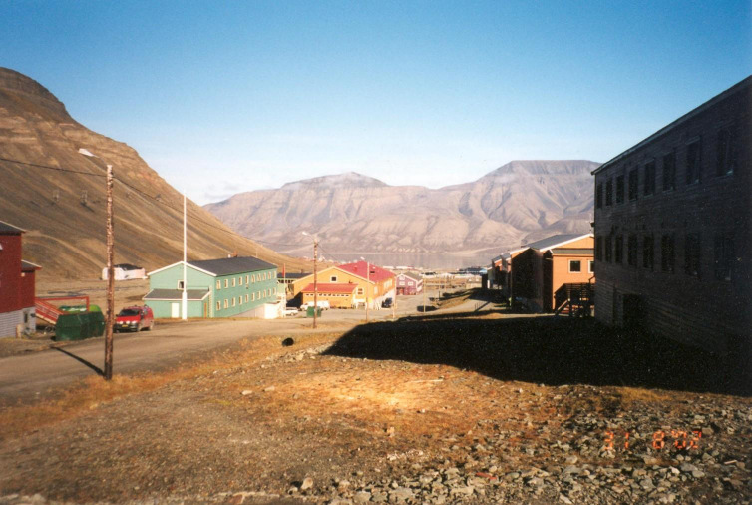
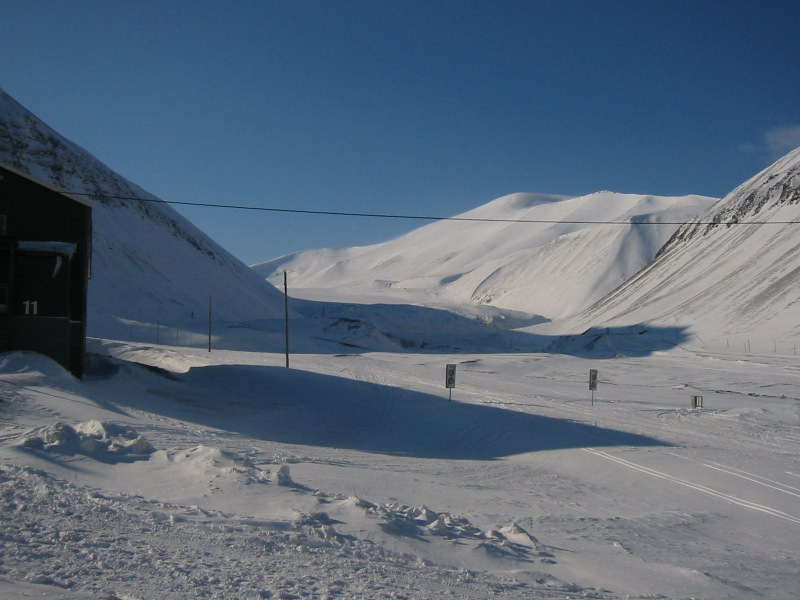
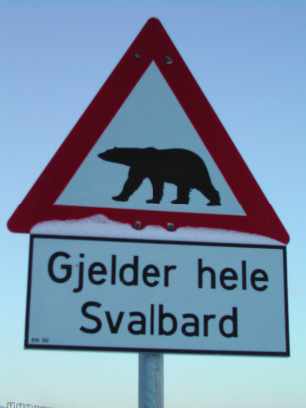
A special feature of Svalbard is that you can meet a polar bear at any time. During the first week of each semester, UNIS therefore runs a safety course. Besides the particular Arctic dangers (frostbite, crevasses, avalanches, …), you learn how to behave towards polar bears. Part of the course is shooting practice, because everyone leaving town has to carry a rifle. It may only be used in extreme self-defence, however, since polar bears are protected on Svalbard, and the Sysselmann (the governor, the highest representative of the Norwegian state and also head of police) enforces this strictly.
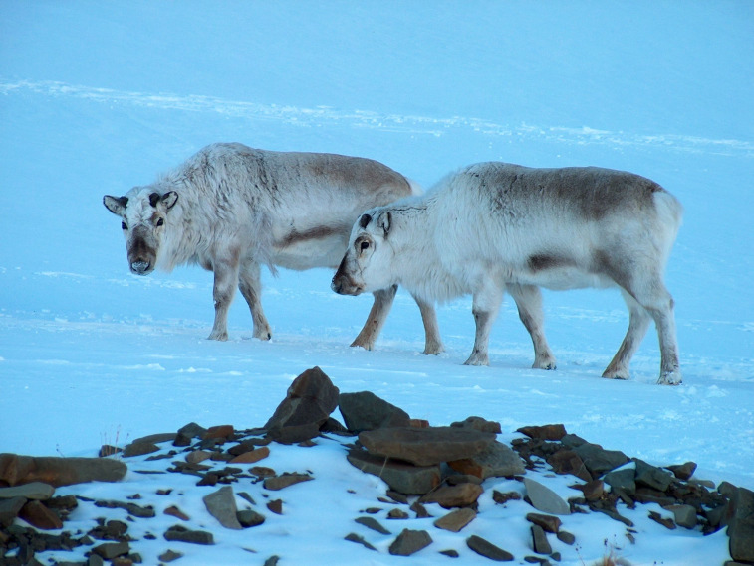
Less dangerous and more common are reindeer, which you may meet on your daily way between the university and Nybyen. Speaking of the way: the distance between Nybyen and UNIS is about 3 km. In good weather you can walk it in half an hour (there is no public transport), whereas in a snowstorm you can watch heavily wrapped-up people battling the relentless forces of nature. It is still handy to get a bicycle, even though the treacherous road conditions combined with strong wind can be quite a challenge.
Which brings us to the weather. Well, what can one say about the weather: it is winter almost all year round. The first snow in town surprised us at the beginning of September, and when we left Svalbard in mid-June, there was still snow almost down to sea level. In autumn, temperatures are around 0 to −20 °C. We were lucky enough to experience a near-record, week-long thaw at the beginning of December with rain and above-zero temperatures, which turned all roads and paths into ice rinks. The average local does not mind, since they only get around by car, and cars have studded tyres. For students, practically the only ones who walk or cycle, things are rather more difficult.
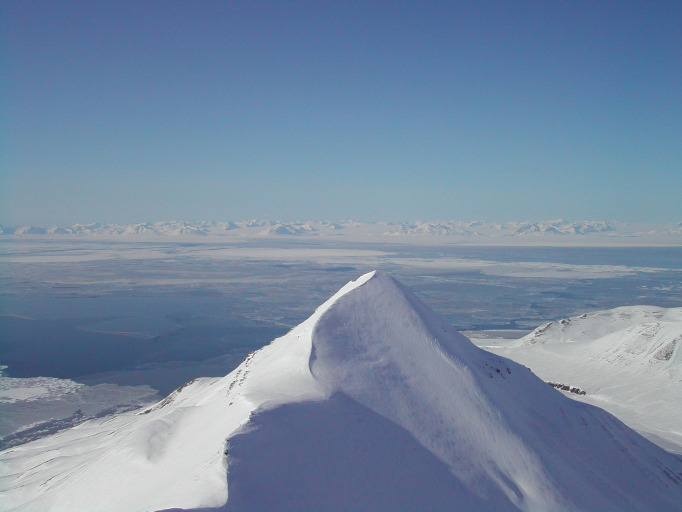
At the end of October, it is time to say goodbye to the sun; for several weeks, the landscape is bathed in a mystical blue. From then on, the aurora, the moon and the stars are the only lights in the sky. We especially felt sorry for the new students of the spring semester, who had to complete their safety training in darkness and cold in mid-January. They probably had no real idea of their surroundings for about another month.
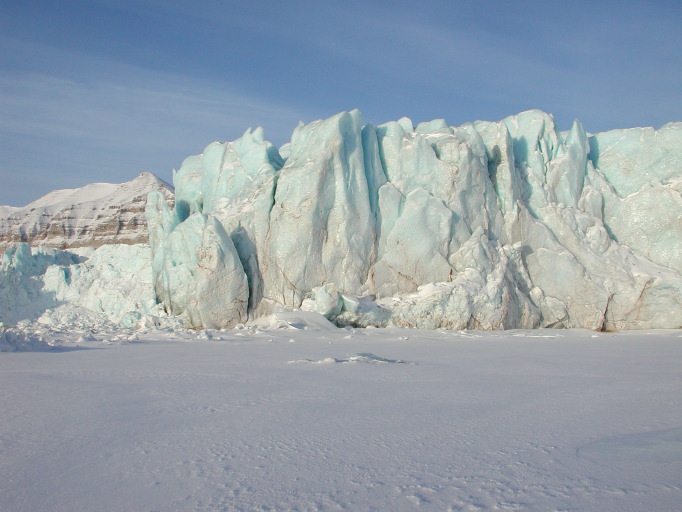
From mid-February, the sun can finally be admired again from the highest mountain tops; another three weeks pass before it returns to the town. Then the so-called Sun Festival is celebrated for a week, with countless events and concerts. Particularly fun is "Ta sjansen", a race with adventurous home-made sledges down the slope on the other side of Adventdalen. Now the undisputedly best time for excursions begins, above all by snowmobile, which, besides helicopters and ships, is the only means of transport in the roadless surroundings of Longyearbyen. Popular trips go to Pyramiden, an abandoned Russian mining settlement about 100 km away, now a ghost town, or to the blue glacier front of Tunabreen, which calves into Tempelfjorden with an ice cliff more than 25 m high. A trip to the Russian neighbours in Barentsburg is also very popular; cultural exchanges and sports competitions are organised with them regularly.
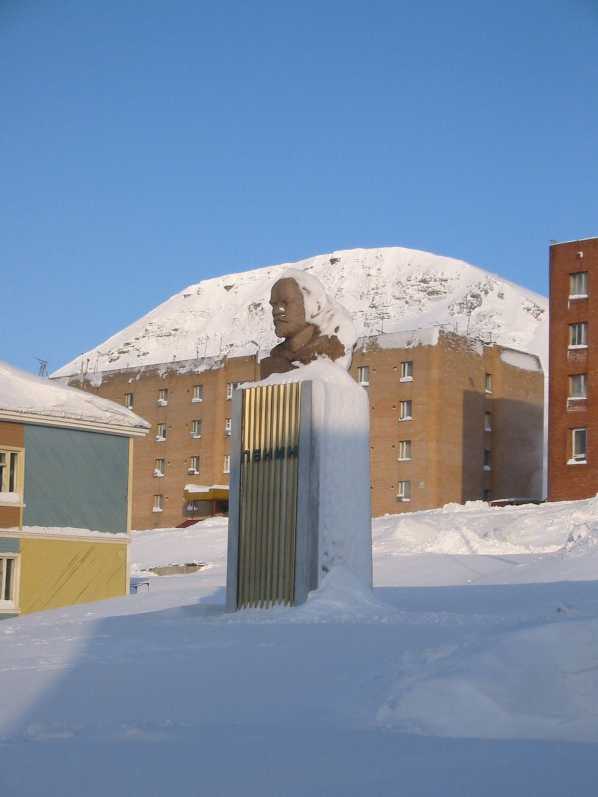
A golden rule says that it only gets really cold on Svalbard once the sun returns. Indeed, we recorded the lowest temperatures, −35 °C, in April. At that time we were on an excursion inland and could test how well our equipment coped with winter. Some students got minor frostbite, but it must be said that the clothing provided by UNIS for the excursions normally copes with the conditions.
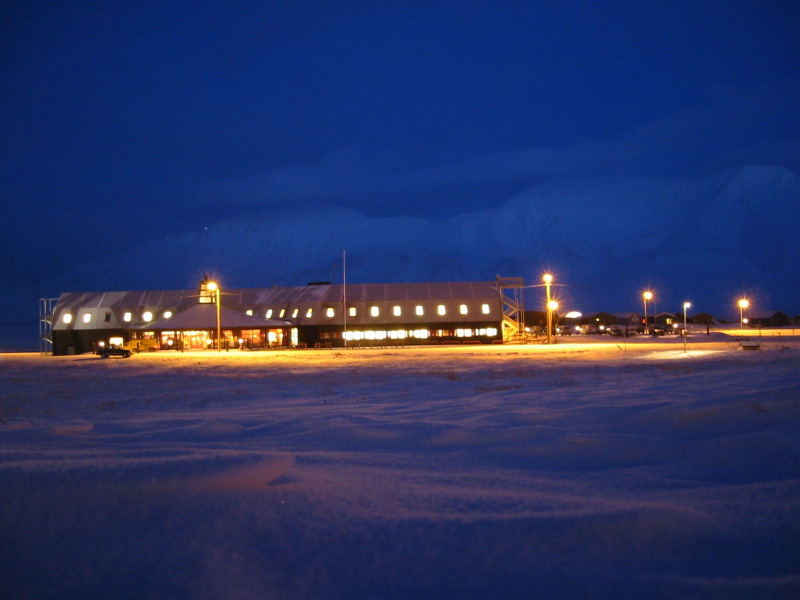
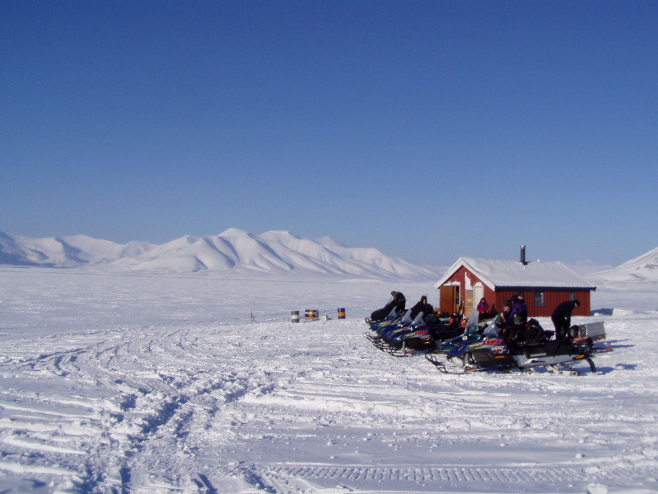
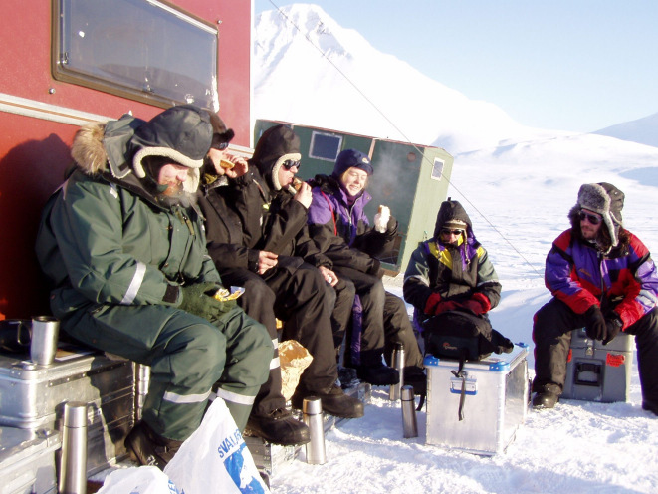
From then on, the nights get shorter and shorter, and soon the midnight sun takes over. It is truly fascinating to lie in the sun at midnight. From the end of May, daytime temperatures slowly rise above freezing again, and on calm days you can already sit on the roof of the brakke in a T-shirt.
In summer, temperatures rarely exceed 15 °C, yet you can see locals and students alike in T-shirts and shorts in town. After almost a year there, these conditions really do feel almost like high summer. (Returning to the record-breaking German summer of 2003 was a gigantic temperature shock.)
Norway shows a strong financial commitment, partly politically motivated, to promote research, tourism and the economy on this small archipelago and to make life there pleasant. This is also reflected in the facilities of the local university. UNIS has about 100–200 students per year, around 50% of them Norwegian. The rest come mainly from many European countries, plus a few from further afield; we even met Tibetans during our stay. It is easy to get to know fellow students, since an icebreaker party is organised at the beginning of every semester.
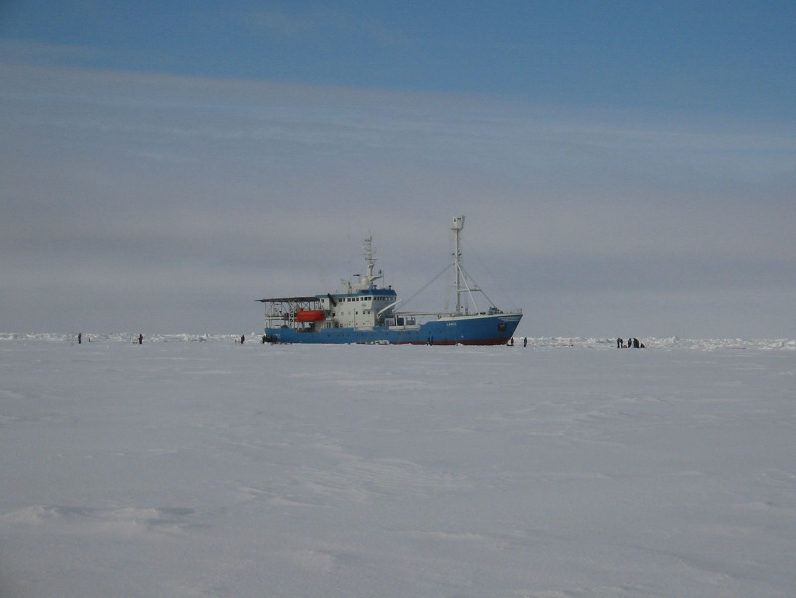
Apart from that, there is a party practically every weekend, since all students live close to each other. The weekend is kicked off by the so-called "Friday Gathering", held in a cosy atmosphere by the fireplace in the UNIS entrance hall. Spontaneous pizza evenings are popular too, and thanks to alcohol prices that are low by Norwegian standards (normal by German ones), they quickly turn into lively parties.
A proper party night usually continues at Huset, the local disco bar, where a beer costs 40 kroner (about €5). The music takes some getting used to, but that does not spoil the good mood. You often meet tipsy miners there who work at the Svea coal mine, 60 km away.
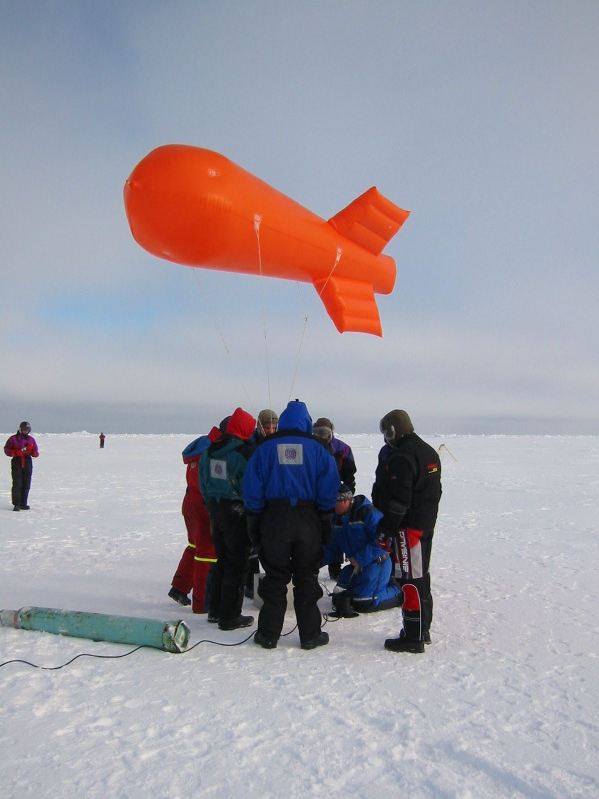
When the sun is shining again after a strenuous night, skiing or snowboarding towed by snowmobile is a popular pastime. Apart from the adventurous ski lift of the local school, you otherwise have to climb the slopes yourself with your skis or board, which means 2- to 3-hour ascents for 10-minute descents. The breathtaking views more than make up for it, though, and since the days get longer quickly from March onwards, you can even start a tour at midnight. The ice caves of the nearby Longyearbreen and Larsbreen glaciers are another popular destination, with bizarre ice crystals and formations to marvel at. Anyone wanting a quiet weekend can retreat to the students' own hut in the neighbouring valley of Bjørndalen to be at one with nature.
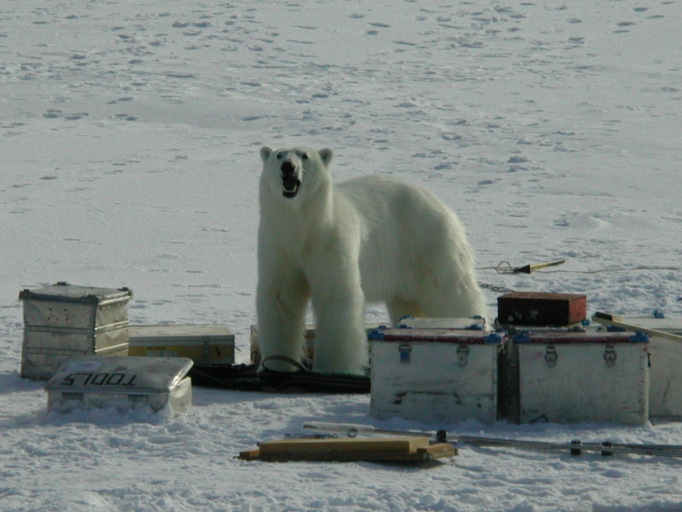
If you are not in the mood for nature, there are plenty of local leisure activities. Particularly popular are the sauna followed by a roll in the snow, as well as swimming, indoor hockey and the indoor climbing wall.
Studying at UNIS
Of course, a stay on Svalbard is not just leisure, but also an interesting course of study. UNIS currently offers four different study programmes: Arctic Biology, Arctic Geology, Arctic Technology and Arctic Geophysics, in which we were enrolled. It covers meteorology, oceanography, snow and ice processes, and the middle and upper polar atmosphere, with a focus on aurora research. A special feature is that a lecturer from the respective field is invited for each part of the course, so we were taught in turn by Canadians, Americans, Scandinavians, Russians, Germans, Spaniards, Britons and others. The opportunities for practical field experiments were unique (also financially).
In the autumn semester we attended Polar Meteorology, Polar Oceanography, Middle Polar Atmosphere and Remote Sensing. In Polar Meteorology we studied the particular meteorological conditions of high Arctic regions, with a focus on determining turbulent fluxes in the atmosphere and radiation budgets over snow- and ice-covered areas. In Polar Oceanography we covered the currents and the formation of different water masses and sea ice in the Arctic Ocean, which are of great importance for the global ocean circulation. On a ship excursion to Fram Strait and the fjords of western Svalbard, we applied the theory in practice, focusing on current measurements and profiles of salinity and temperature. In the Remote Sensing course we used satellite remote sensing algorithms to classify vegetation and surface types from satellite images; the second part of the course dealt with rocket technology and telecommunications. Middle Polar Atmosphere covered the dynamics of the middle atmosphere between 15 and 60 km altitude, as well as radiation and ozone formation.
In the spring semester we took Air–Ice–Sea Interaction, Processes in Snow and Ice, Upper Polar Atmosphere and Radiodiagnostics. Air–Ice–Sea Interaction was the logical continuation of the oceanography course, now focusing on conditions when the sea is ice-covered. On two excursions we carried out measurements on and under the ice of a frozen fjord and in the pack ice off the coast of north-east Greenland, and on each we had a visit from a polar bear. The focus was on determining turbulent fluxes. In Processes in Snow and Ice we studied, for example, the transformation of snow into ice and the formation of glaciers, whose movement and mass balance we investigated on a week-long excursion into the interior of Svalbard. The aurora was the main topic of Upper Polar Atmosphere, from the solar wind and its effect on the Earth's magnetic field to particle precipitation. The EISCAT radar near Longyearbyen is a very advanced instrument for studying the aurora; its details were the subject of the Radiodiagnostics course.
In general, UNIS seemed to have almost unlimited funding. State-of-the-art computers, laboratories and measuring instruments are evidence of this, and the numerous excursions must cost a fair amount of money too.
Of course, every coin has two sides: because of Svalbard's remoteness, the cost of living is extremely high compared with Germany, even higher than on the Norwegian mainland. Unfortunately, only the unhealthy things such as alcohol and tobacco are relatively cheap, while healthier food such as fruit and vegetables is very expensive. A litre of milk costs the equivalent of €2.50 … You should also budget some money for equipment and possibly buying or renting a snowmobile. Snowmobiles in particular usually turn out to be a bottomless pit financially …
Nevertheless, our stay on Svalbard will stay with us forever, and we can only recommend it. Anyone wanting to find out more should visit the UNIS homepage: www.unis.no.
Ulrich and Peer
Publications
Peer-reviewed articles, theses and reports.
Preprints (not peer-reviewed)
- Pennino, A., F. Zanetta, M. Cattaneo, C. Merker, R. Radev, J. Bhend, L. Frey, H. de Laroussilhe, O. Miralles, C. Osuna, D. Nerini, A. Pauling, D. Hupp, U. Hamann, et al. (2026). Varda-single-1.0: deterministic data-driven weather forecasting at 1 km resolution over Switzerland's complex topography. arXiv preprint, arXiv:2610.01835; submitted to Geoscientific Model Development
- Pacey, G., O. Miralles, U. Hamann, and O. Martius (2026). Exploring the role of input data on hail nowcast skill using spatiotemporal neural networks. arXiv preprint, arXiv:2609.04427; submitted to Geophysical Research Letters
- Leinonen, J., U. Hamann, D. Nerini, U. Germann, and G. Franch (2023). Latent diffusion models for generative precipitation nowcasting with accurate uncertainty quantification. arXiv:2304.12891
Peer-reviewed publications
2024
- Roccetti, G., L. Bugliaro, F. Gödde, C. Emde, U. Hamann, M. Manev, M. F. Sterzik, and C. Wehrum (2024). HAMSTER: Hyperspectral Albedo Maps dataset with high Spatial and TEmporal Resolution. Atmospheric Measurement Techniques, 17, 6025–6046. doi:10.5194/amt-17-6025-2024
- Rombeek, N., J. Leinonen, and U. Hamann (2024). Exploiting radar polarimetry for nowcasting thunderstorm hazards using deep learning. Natural Hazards and Earth System Sciences, 24, 133–144. doi:10.5194/nhess-24-133-2024
2023
- Leinonen, J., U. Hamann, I. V. Sideris, and U. Germann (2023). Thunderstorm nowcasting with deep learning: a multi-hazard data fusion model. Geophysical Research Letters, 50(8), e2022GL101626. doi:10.1029/2022GL101626
2022
- Leinonen, J., U. Hamann, U. Germann, and J. R. Mecikalski (2022). Seamless lightning nowcasting with recurrent-convolutional deep learning. Artificial Intelligence for the Earth Systems. doi:10.1175/AIES-D-22-0043.1
- Leinonen, J., U. Hamann, U. Germann, and J. R. Mecikalski (2022). Nowcasting thunderstorm hazards using machine learning: the impact of data sources on performance. Natural Hazards and Earth System Sciences, 22, 577–597. Link
2018
- Beusch, L., L. Foresti, M. Gabella, and U. Hamann (2018). Satellite-based rainfall retrieval: from generalized linear models to artificial neural networks. Remote Sensing, 10(6), 939. doi:10.3390/rs10060939
- Raspaud, M., D. Hoese, A. Dybbroe, P. Lahtinen, A. Devasthale, M. Itkin, U. Hamann, L. Rasmussen, E. S. Nielsen, T. Leppelt, A. Maul, C. Kliche, and H. Thorsteinsson (2018). PyTroll: an open source, community driven Python framework to process Earth observation satellite data. Bulletin of the American Meteorological Society. doi:10.1175/BAMS-D-17-0277.1
- Romano, S., P. Burlizzi, S. Kinne, F. De Tomasi, U. Hamann, and M. R. Perrone (2018). Radiative impact of Etna volcanic aerosols over south eastern Italy on 3 December 2015. Atmospheric Environment. doi:10.1016/j.atmosenv.2018.03.038
2017
- Gabella, M., P. Speirs, U. Hamann, U. Germann, and A. Berne (2017). Measurement of precipitation in the Alps using dual-polarization C-band ground-based radars, the GPM spaceborne Ku-band radar, and rain gauges. Remote Sensing, 9(11), 1147. Link
2016
- Emde, C., R. Buras-Schnell, A. Kylling, B. Mayer, J. Gasteiger, U. Hamann, J. Kylling, B. Richter, C. Pause, T. E. Dowling, and L. Bugliaro (2016). The libRadtran software package for radiative transfer calculations (version 2.0.1). Geoscientific Model Development, 9, 1647–1672. doi:10.5194/gmd-9-1647-2016
2014
- Hamann, U., A. Walther, B. Baum, R. Bennartz, L. Bugliaro, M. Derrien, P. Francis, A. Heidinger, S. Joro, A. Kniffka, H. Le Gléau, M. Lockhoff, H.-J. Lutz, J. F. Meirink, P. Minnis, R. Palikonda, R. Roebeling, A. Thoss, S. Platnick, P. Watts, and G. Wind (2014). Remote sensing of cloud top pressure/height from SEVIRI: analysis of ten current retrieval algorithms. Atmospheric Measurement Techniques, 7, 2839–2867. doi:10.5194/amt-7-2839-2014
- Roebeling, R., B. Baum, R. Bennartz, U. Hamann, A. Heidinger, J. F. Meirink, M. Stengel, A. Thoss, A. Walther, and P. Watts (2014). Summary of the Fourth Cloud Retrieval Evaluation Workshop. Bulletin of the American Meteorological Society. doi:10.1175/BAMS-D-14-00184.1
2013
- Roebeling, R., B. Baum, R. Bennartz, U. Hamann, A. Heidinger, A. Thoss, and A. Walther (2013). Evaluating and improving cloud parameter retrievals. Bulletin of the American Meteorological Society, 94, ES41–ES44. Link
Theses
- Hamann, U. (2010). Die Erwärmungsrate der tropischen Tropopausenregion. PhD thesis, Ludwig-Maximilians-Universität München. Also published as DLR-Forschungsbericht DLR-FB-2010-32.
- Hamann, U. (2005). Die Entwicklung des Monte-Carlo-Strahlungstransfer-Modells PROMT. Diploma thesis, Leibniz University of Hannover.
EUMETSAT fellowship reports
- Hamann, U. (2013). Fellowship report for the CLOUDSTATE fellowship 2013.
- Hamann, U. (2012). Fellowship report for the CLOUDSTATE fellowship 2012.
- Hamann, U. (2011). Fellowship report for the CLOUDSTATE fellowship 2011.
Technical reports and documentation
- Mayer, B., A. Kylling, C. Emde, R. Buras, U. Hamann, J. Gasteiger, and B. Richter (2015). libRadtran user's guide.
- Emde, C., A. Kylling, R. Buras, B. Mayer, F. Schreier, and U. Hamann (2010). Towards a generic radiative transfer model for the Earth's surface-atmosphere system: ESAS-Light. Final report, ESTEC Contract No. AO/1-5433/07/NL/HE.
Newsletters
- Roebeling, R., B. Baum, R. Bennartz, U. Hamann, A. Heidinger, A. Thoss, and A. Walther (2012). Third Cloud Retrieval Evaluation Workshop (CREW-3). GEWEX News, February 2012.
Talks & Posters
Talks and posters, newest first. Keynotes and invited talks are marked.
2026
- Hamann, U., M. Buzzi, G. Pacey, O. Miralles, N. Rombeek, N. Tarin Burriel, J. van Thor, P. Grochal, D. Kavachevich, P. Nasirifard, P. Juda, U. Germann, and J. Leinonen. COALITION-4: probabilistic multi-hazard thunderstorm nowcasting with deep learning for robust automated early warnings. EMS Annual Meeting, Utrecht, Netherlands, 6–11 Sep 2026, EMS2026-302.
- Landmann, J. M., R. Attinger, G. Aznar, H. Barras, U. Hamann, T. Reiniger, K. Wehrli, S. Exterde, T. Jordi, and C. Stocker. adMET: integrating probabilistic weather information into aviation decision-making. EMS Annual Meeting, Utrecht, Netherlands, 6–11 Sep 2026, EMS2026-108.
- Landmann, J. M., R. Attinger, T. Hungerland, G. Aznar, and U. Hamann. Radar-based ground truth for deep learning towering cumulus (TCU) nowcasting: towards a minimum definition for aviation. EMS Annual Meeting, Utrecht, Netherlands, 6–11 Sep 2026, EMS2026-124.
- Spirig, C. and the SeamlessWeather Team (incl. U. Hamann). Seamless weather forecasting through machine learning. EMS Annual Meeting, Utrecht, Netherlands, 6–11 Sep 2026, EMS2026-587.
- Pacey, G., O. Miralles, M. Buzzi, U. Hamann, and O. Romppainen-Martius. Improving nowcasts of convective hazards using deep learning. ENWFC-2026, Copenhagen, Denmark, 18–21 May 2026.
- Buzzi, M., U. Hamann, N. Tarin Burriel, J. van Thor, P. Grochal, D. Kavachevich, G. Pacey, O. Miralles, P. Juda, N. Rombeek, and J. Leinonen. Nowcasting of thunderstorm hazards with deep learning: performance report and experiences of the first convective season in operations. ENWFC-2026, Copenhagen, Denmark, May 2026. Poster
- Pacey, G., U. Hamann, O. Miralles, and O. Martius. Improving nowcasts of hail in Switzerland using deep neural networks. 5th ECMWF–ESA Workshop on Machine Learning for Earth Observation and Prediction, Bologna, Italy, 13–17 April 2026. Poster
2025
- Hamann, U., L. Nisi, I. Mahlstein, M. Buzzi, M. Cattaneo, N. Tarin Burriel, P. Juda, N. Rombeek, G. Pacey, O. Miralles, and J. Leinonen. Nowcasting of thunderstorm hazards with deep learning: performance report of the first convective season in operations. 12th European Conference on Severe Storms, Utrecht, Netherlands, 17–21 Nov 2025 (poster).
- Pacey, G., U. Hamann, O. Miralles, and O. Romppainen-Martius. Nowcasting convective hazards in complex topography using machine learning. ECSS 2025, Utrecht, Netherlands.
- Hamann, U., et al. A regional perspective on nowcasting from Europe. Virtual WMO Workshop on Core Satellite Data for Nowcasting, online, 15–16 Oct 2025. Invited
- Jequier, Z., S. Balmelli, U. Hamann, M. Sassi, and L. Clementi. Analysis of the parallax effect of MTG-LI group and flash data over the Alps and prospects for a real-time parallax correction at MeteoSwiss. EUMETSAT Meteorological Satellite Conference, Lyon, France, Sep 2025.
- Hamann, U., I. Sideris, L. Foresti, D. Nerini, J. Leinonen, A. Ntoumos, and U. Germann. Precipitation nowcasting: from Lagrangian models to advanced ML approaches. PrePEP 2025, Bonn, Germany, 17–21 Mar 2025. Keynote
2024
- Hamann, U., J. Leinonen, F. Zanetta, D. Nerini, M. Buzzi, N. Rombeek, P. Juda, and U. Germann. The thunderstorm nowcasting algorithm COALITION-4 and the deep learning wind analysis of MeteoSwiss. EUMETSAT Integrated Nowcasting Tools Workshop, Darmstadt, Germany, 23–25 Jan 2024. Invited
2023
- Leinonen, J., U. Hamann, D. Nerini, U. Germann, and G. Franch. Realistic ensemble nowcasts of precipitation using diffusion deep generative models. UrbanRain23, Pontresina, Switzerland, Nov–Dec 2023.
- Hamann, U., J. Leinonen, N. Rombeek, and U. Germann. Predictor analysis of a deep learning thunderstorm nowcasting algorithm. EUMETSAT Meteorological Satellite Conference, Malmö, Sweden, Sep 2023.
- Hamann, U., J. Leinonen, N. Rombeek, and U. Germann. Contribution of NWP variables to the nowcast of thunderstorm hazards in a deep learning framework. European Conference on Severe Storms, Bucharest, Romania, 8–12 May 2023.
- Leinonen, J., U. Hamann, and U. Germann. Latent diffusion models for generative nowcasting and uncertainty quantification of precipitation fields. EGU General Assembly, Vienna, Austria, Apr 2023. Solicited
- Leinonen, J., U. Hamann, I. Sideris, and U. Germann. Predictive hazards from convective systems with deep learning. EGU General Assembly, Vienna, Austria, Apr 2023. Solicited
- Rombeek, N., J. Leinonen, and U. Hamann. Exploiting radar polarimetry for nowcasting of convective hazards using deep learning. EGU General Assembly, Vienna, Austria, Apr 2023.
- Rombeek, N., J. Leinonen, and U. Hamann. Nowcasting thunderstorm hazards with radar polarimetry using deep learning. 11th European Conference on Severe Storms, Bucharest, Romania, 8–12 May 2023.
2022
- Hamann, U., J. Figueras i Ventura, J. Zeder, S. Nath, L. Clementi, and U. Germann. Machine learning based thunderstorm nowcasting. EUMETSAT Meteorological Satellite Conference, Session S02-E: Nowcasting applications, Brussels, Belgium, 19–23 Sep 2022.
- Leinonen, J., and U. Hamann. Deep learning based seamless nowcasting of thunderstorm hazards from multi-source data. EUMETSAT Meteorological Satellite Conference, Session S02-E: Nowcasting applications, Brussels, Belgium, 19–23 Sep 2022.
- Leinonen, J., U. Hamann, and U. Germann. Seamless prediction of multiple thunderstorm hazards with deep learning. ECMWF–ESA Workshop on Machine Learning for Earth Observation and Prediction, 15 Nov 2022.
- Leinonen, J., U. Hamann, and U. Germann. Nowcasting thunderstorm hazards with neural networks from multi-source data. ERAD 2022, Session: Artificial Intelligence, Locarno, Switzerland, 29 Aug – 2 Sep 2022.
- Leinonen, J., and U. Hamann. Seamlessly nowcasting lightning with convolutional-recurrent deep learning. European Nowcasting Conference, online, 21–25 Mar 2022. Keynote
- Buzzi, M., D. Nerini, M. Sassi, U. Hamann, and I. V. Sideris. INCA-CH: the Swiss seamless nowcasting system. European Nowcasting Conference, online, 21–25 Mar 2022.
2021
- Leinonen, J., U. Hamann, U. Germann, and J. R. Mecikalski. Machine learning for seamless thunderstorm nowcasting from multiple data sources. EUMETSAT AI/ML Seminar, online, 6 Oct 2021.
- Hamann, U., J. Zeder, S. Nath, J. Figueras i Ventura, L. Clementi, L. Foresti, A. Hering, M. Sassi, and U. Germann. On the usage of machine learning for thunderstorm nowcasting. EUMETSAT Meteorological Satellite Conference, online, 20–24 Sep 2021.
- Leinonen, J., U. Hamann, L. Clementi, A. Rigazzi, and J. R. Mecikalski. Hazard-specific thunderstorm nowcasting using machine learning with satellite, radar and NWP data. EUMETSAT Meteorological Satellite Conference, online, 20–24 Sep 2021.
- Barras, H., O. Romppainen-Martius, A. Hering, U. Germann, U. Hamann, L. Foresti, S. Nath, D. Nerini, and J. Zeder. Nowcasting hail with machine learning. 3rd European Hail Workshop, online, 15–18 Mar 2021.
- Hering, A., L. Nisi, U. Hamann, and U. Germann. The potential of lightning-jumps for nowcasting hailstorms in the Alpine area. 3rd European Hail Workshop, online, 15–18 Mar 2021.
2019
- Hamann, U., J. Zeder, S. Nath, L. Clementi, L. Foresti, A. Hering, J. R. Mecikalski, D. Nerini, L. Nisi, A. Rigazzi, O. Romppainen-Martius, M. Sassi, and U. Germann. Synergetic use of MTG FCI and LI for thunderstorm nowcasting. EUMETSAT MTG / EPS-SG User Days, Darmstadt, Germany, 12–14 Nov 2019. Invited
- Nath, S., H. Barras, L. Clementi, L. Foresti, U. Hamann, A. Hering, D. Nerini, L. Nisi, M. Sassi, J. Zeder, and U. Germann. Towards automated multi-sensor thunderstorm warning suggestions. 10th European Conference on Severe Storms, Krakow, Poland. Poster Best poster award
- Hamann, U., J. Zeder, H. Barras, L. Clementi, L. Foresti, A. Hering, S. Nath, D. Nerini, L. Nisi, M. Sassi, and U. Germann. A novel multi-sensor nowcast algorithm of thunderstorm intensity using machine learning. 10th ECSS, Krakow, Poland. Oral
- Barras, H., U. Hamann, L. Foresti, A. Hering, D. Nerini, J. Zeder, U. Germann, and O. Martius. Improving hail nowcasting by combining crowd-sourced hail reports with machine learning. 10th ECSS, Krakow, Poland.
- Hamann, U., J. Zeder, L. Beusch, L. Clementi, L. Foresti, A. Hering, D. Nerini, L. Nisi, M. Sassi, and U. Germann. Nowcasting of thunderstorm severity with machine learning in the Alpine region. 3rd European Nowcasting Conference, Madrid, Spain, 24–26 Apr 2019. Oral
2018
- Hamann, U., N. Besic, L. Beusch, L. Clementi, L. Foresti, M. Gabella, A. Hering, J. Zeder, D. Nerini, L. Nisi, M. Sassi, and U. Germann. Strategies for probabilistic nowcasting of thunderstorms by exploiting satellite, radar, and lightning observations with artificial neural networks. EUMETSAT Conference, Tallinn, Estonia. Oral
- Zeder, J., U. Hamann, D. Nerini, L. Foresti, L. Clementi, A. Hering, and U. Germann. Comparison of thunderstorm characteristics as seen by SEVIRI and radar regarding lightning and hail initiation. EUMETSAT Conference, Tallinn, Estonia. Poster
- Tom, M., M. Sütterlin, D. Bouffard, M. Rothermel, U. Hamann, A. Duguay-Tetzlaff, S. Wunderle, and E. Baltsavias. Integrated lake ice monitoring in Swiss lakes. EUMETSAT Conference, Tallinn, Estonia. Poster
- Germann, U., et al. (incl. U. Hamann). A rendezvous of research and operations: the new Swiss radar generation. ERAD 2018, Ede-Wageningen, Netherlands.
- Hering, A., L. Nisi, U. Hamann, and U. Germann. The nowcasting potential of lightning-jumps in convective cells tracked by radar in complex orography. ERAD 2018, Ede-Wageningen, Netherlands.
2017
- Hamann, U., et al. Integrated thunderstorm nowcast exploiting satellite, radar and high resolution NWP data. EUMETSAT Conference, Rome, Italy. Oral
- Hamann, U., N. Besic, L. Beusch, M. Buzzi, L. Clementi, J. Figueras i Ventura, A. M. Hering, E. Leonarduzzi, A. Leuenberger, D. Nerini, L. Nisi, M. Sassi, and U. Germann. Combined use of complementary methods for a continuous thunderstorm forecast. 9th European Conference on Severe Storms, Pula, Croatia, 18 Sep 2017, ECSS2017-134. Oral
- Beusch, L., et al. (incl. U. Hamann). Thunderstorm nowcasting by applying machine learning to a multi-sensor observation and NWP model data base. 9th ECSS, Pula, Croatia.
- Hering, A., L. Nisi, U. Hamann, N. Besic, S. Trefalt, and U. Germann. Object-based operational nowcasting of severe thunderstorms in the Alpine area. 9th ECSS, Pula, Croatia, 18–22 Sep 2017, ECSS2017-119.
- Besic, N., et al. (incl. U. Hamann). Operational hydrometeor classification using polarimetric radar: focus on hail detection. HyMeX Workshop, Barcelona, Spain.
- Hamann, U., et al. Nowcasting of thunderstorms and severe convection in Switzerland. 2nd European Nowcasting Conference, Offenbach, Germany. Oral
- Germann, U., et al. (incl. U. Hamann). A new era of hail monitoring, forecasting and climatology in Switzerland. 2nd European Hail Workshop, Bern, Switzerland.
- Hamann, U., et al. Hail nowcast exploiting radar and satellite observations. 2nd European Hail Workshop, Bern, Switzerland. Oral
2016
- Leonarduzzi, E., U. Hamann, et al. The estimation of cloud motion for the tracking of convective cells. EUMETSAT Conference, Darmstadt, Germany. Poster
- Hamann, U., et al. Nowcasting of thunderstorms and severe convection in Switzerland. EUMETSAT Conference, Darmstadt, Germany. Oral
- Hamann, U., et al. Nowcasting of thunderstorms and severe convection in Switzerland. CGMS International Clouds Working Group, Lille, France. Oral
- Hamann, U., et al. Analysing convective events in Switzerland using MSG, radar and lightning observations (COALITION Second Generation). EUMETSAT Convection Working Group Workshop, Florence, Italy. Oral
2015
- Hamann, U., et al. Early detection of thunderstorms using satellite and radar observations. European Conference on Severe Storms, Wiener Neustadt, Austria. Oral
- Hering, A., et al. (incl. U. Hamann). Fully automated thunderstorm warnings and operational nowcasting at MeteoSwiss. ECSS, Wiener Neustadt, Austria.
- Hamann, U., L. Nisi, L. Clementi, J. Figueras i Ventura, M. Gabella, A. M. Hering, I. Sideris, S. Trefalt, and U. Germann. Observing convection with satellite, radar, and lightning measurements. EGU General Assembly, Vienna, Austria, 17 Apr 2015, EGU2015-12054. Oral
2014
- Hamann, U., A. Walther, S. Kox, A. Takeuchi, R. Bennartz, J. F. Meirink, B. Baum, and R. Roebeling. The current status of cloud top height remote sensing from SEVIRI: updated assessment including two new algorithms. EUMETSAT Conference, Geneva, Switzerland. Oral
- Hamann, U., L. Nisi, A. Hering, L. Clementi, M. Gabella, and U. Germann. Investigating the typical development of thunderstorms using satellite, radar and lightning observations. EUMETSAT Conference, Geneva, Switzerland. Poster
- Roebeling, R., et al. (incl. U. Hamann). Outcome of the Fourth Cloud Retrieval Evaluation Workshop. EUMETSAT Conference, Geneva, and EGU General Assembly, Vienna.
2010–2013
- Hamann, U., et al. (2013). Towards understanding differences between cloud retrievals from passive imagers. EUMETSAT Conference, Vienna, Austria. Poster
- Hamann, U., R. Bennartz, J. F. Meirink, R. Roebeling, and A. Thoss (2013). Inter-comparison of cloud detection and cloud top height retrievals using the CREW data base. AIP Conf. Proc. 1531, 460–463, International Radiation Symposium 2012, Berlin. Poster
- Roebeling, R., et al. (incl. U. Hamann) (2013). Outcome of the Third Cloud Retrieval Evaluation Workshop. AIP Conf. Proc. 1531, 416–419.
- Hamann, U., et al. (2012). The CREW inter-comparison of SEVIRI cloud retrievals. AGU Fall Meeting, San Francisco, USA. Oral
- Hamann, U., et al. (2012). Inter-comparison of cloud property retrievals using the CREW data base. EUMETSAT Conference, Sopot, Poland. Oral
- Roebeling, R., et al. (incl. U. Hamann) (2012). Outcome of the Third Cloud Retrieval Evaluation Workshop. EGU General Assembly, Vienna, Austria.
- Hamann, U. (2011). Results of the CREW-3 intercomparison. CREW-3, Madison, Wisconsin, USA. Oral
- Hamann, U., et al. (2011). Validation of present-day cloud retrieval methods. EUMETSAT Conference, Oslo, Norway. Oral
- Schumann, U., B. Mayer, U. Hamann, and K. Graf (2010). Radiative heating in contrail cirrus. EGU General Assembly, Vienna, Austria.
Before 2010
- Weinzierl, B., et al. (incl. U. Hamann) (2009). Fire and ice: aerosol properties of forest fire plumes over Greenland during POLARCAT-GRACE 2008. MoCa-09 Joint Assembly, Montreal, Canada.
- Hamann, U., and B. Mayer (2008). The radiation budget of the tropical tropopause layer. International Radiation Symposium, Foz do Iguaçu, Brazil. Oral
- Hamann, U., and B. Mayer (2007). Horizontal structure of the radiative heating rate in the tropical tropopause layer. EGU General Assembly, Vienna, Austria. Oral
- Hamann, U., and B. Mayer (2006). Impact of clouds on the radiation budget of the tropical tropopause layer. EGU General Assembly, Vienna, Austria. Poster
- Hamann, U., and B. Mayer (2005). Radiation balance of the tropical transition layer. Summer school on the Upper Troposphere and Lower Stratosphere in Climate, Cargèse, France. Poster
- Hamann, U., G. Seckmeyer, S. Raasch, and B. Mayer (2004). Development of the Monte-Carlo radiative transfer model PROMT. International Radiation Symposium, Busan, South Korea. Poster
Funding
Fellowships and positions acquired through competitive proposals.
- 2027–2029
- EUMETSAT fellowship (three years), principal applicant and supervisorPostdoc position funded by EUMETSAT: "Unlocking the value of Meteosat Third Generation for the next generation of regional weather forecasting models". Selected in the 2025 EUMETSAT call for three research fellowships, as the Swiss proposal. Proposal ranked first.
- Goal: integrate geostationary satellite observations directly into the machine-learning weather prediction model Varda, to enable rapid-update forecasting that merges nowcasting and ML-based prediction.
- Approach: a multiple encoder–decoder architecture in the open-source Anemoi framework, first with MSG SEVIRI and then, via sensor transfer learning, with MTG FCI, LI and IRS.
- Consortium: MeteoSwiss (host), the ECEO Lab at EPFL (Prof. Devis Tuia) and the High-Resolution Weather and Climate Modeling group at ETH Zurich / C2SM (Prof. Andreas Prein).
- 2020–2023
- EUMETSAT fellowship (three years), principal applicant and supervisorPostdoc position funded by EUMETSAT: "Seamless Artificially Intelligent Thunderstorm Nowcasts" (fellowship topic: thunderstorm detection and nowcasting using multi-sensor datasets and advanced machine learning), fellow: Jussi Leinonen. Selected in the 2018 EUMETSAT call for two research fellowships on "Preparation of innovative nowcasting applications using novel MTG capabilities", as the Swiss proposal. Proposal ranked first.
- Goal: nowcasts of the initiation and evolution of thunderstorms and their hazards, combining satellite observations with radar, lightning and NWP data using artificial intelligence.
- Approach: preparation for the new MTG instruments FCI, LI and IRS using precursor data from GOES ABI and GLM and from IASI, CrIS and AIRS, and extension of the MeteoSwiss multi-sensor nowcasting system with deep learning on GPU supercomputers.
- Partners: University of Alabama in Huntsville (Prof. John Mecikalski), Cray EMEA Research Laboratory (Dr Alessandro Rigazzi) and the Mobiliar Lab for Natural Risks, University of Bern (Prof. Olivia Romppainen-Martius).
- Outcome: the deep learning model COALITION-4, first place in the Weather4cast 2021 challenge and several peer-reviewed publications.
Supervision
Postdocs, fellows and trainees I have supervised.
Current and upcoming
- 2027–2029
- N.N., EUMETSAT fellow, 3 yearsImplementation of MTG observations into the AI weather prediction model Varda.
- May 2025 – May 2027
- George Pacey, postdoc, University of Bern, 2 yearsCo-supervised with Prof. Olivia Romppainen-Martius: improving deep learning nowcasts of convective hazards, in particular hail, within the COALITION-4 framework. Publication: Pacey et al. (2026).
Postdocs and fellows
- Oct 2020 – Sep 2023
- Jussi Leinonen, EUMETSAT fellow, 3 yearsThunderstorm detection and nowcasting using multi-sensor datasets and advanced machine learning. Jussi was the main developer of the deep learning model COALITION-4, and his recurrent neural network won first place in the Weather4cast 2021 challenge. Publications: Leinonen (2021), Leinonen et al. (2022a), Leinonen et al. (2022b), Leinonen et al. (2023a), Leinonen et al. (2023b).
Internships
- Aug 2022 – Jul 2023
- Nathalie Rombeek, 12 monthsCo-supervised with Jussi Leinonen: implementation of polarimetric radar observations and quality indices into the COALITION-4 model, as well as prediction of hail sizes. Publication: Rombeek et al. (2024).
- May 2020 – Jan 2021
- Livia Näf, 9 monthsDevelopment of a multi-sensor nowcasting algorithm of atmospheric instability (temperature and humidity profiles).
- May 2019 – Nov 2019
- Shruti Nath, 7 monthsOptimization of thunderstorm nowcasting and quantification of its uncertainty. Shruti won the Best ECSS Poster Jury Award at the 10th European Conference on Severe Storms 2019. Poster: Nath et al. (2019).
- Jul 2018 – Mar 2019
- Joel Zeder, 9 monthsAutomatic generation of thunderstorm warnings using machine learning methods.
- May 2017 – Jan 2018
- Lea Beusch, 9 monthsDevelopment of a satellite-based rainfall retrieval: from generalized linear models to artificial neural networks. Publication: Beusch et al. (2018).
- Jan 2016 – Sep 2016
- Elena Leonarduzzi, 9 monthsCOALITION second generation: benefits of satellite observations for thunderstorm nowcasting.
Media
Press releases, blog posts and press coverage about our work.
MeteoSwiss
- MeteoSchweiz nutzt künstliche Intelligenz für genauere Gewitterwarnungen MeteoSwiss press release, 27 August 2026 DE
- MeteoSchweiz verbessert Gewitterwarnungen dank KI-Modell MeteoSwiss blog, August 2026 DE
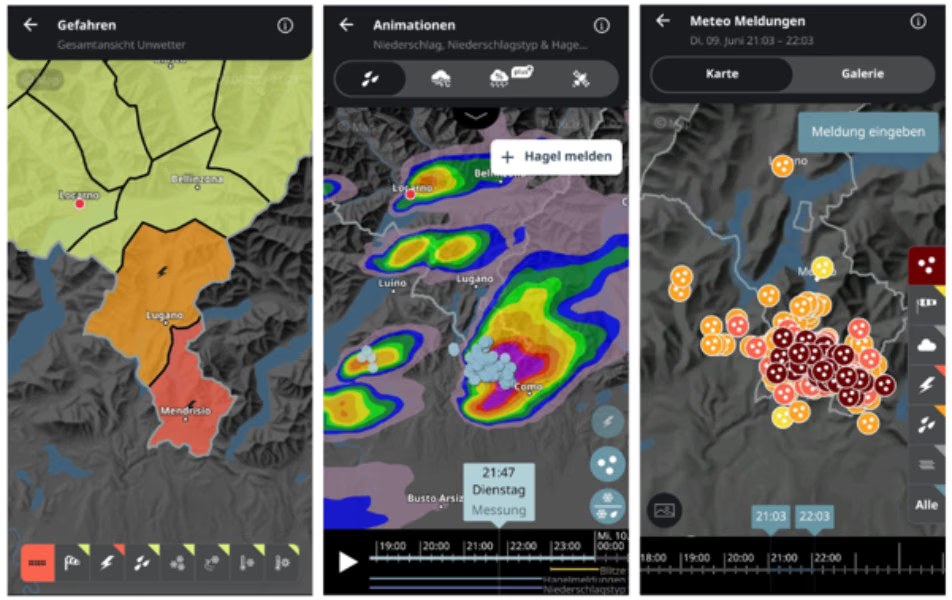
MeteoSwiss App on 9 June 2026: thunderstorm warnings for southern Ticino (left), radar animation with hail (centre) and hail reports from app users (right). - First operational warning produced by COALITION-4 MeteoSwiss blog, June 2026: "9 giugno 2026: la violenta grandinata sul Mendrisiotto – prima parte" and "Supercella sul Mendrisiotto 9 giugno 2026 – parte 2" IT
Press coverage
- MeteoSchweiz warnt neu mit Deep Learning vor Gewittern KI-Newsletter Schweiz, August 2026 (with quotes from me) DE
- MeteoSwiss uses AI to provide more accurate thunderstorm warnings SWI swissinfo.ch, August 2026 EN
- Meteoschweiz setzt auf KI für präzisere Gewittervorhersagen SWI swissinfo.ch (Keystone-SDA), 27 August 2026 DE
- New AI model aims to make thunderstorm warnings more accurate blue News, 27 August 2026 EN
- Neues KI-Modell soll Gewitterwarnungen genauer machen blue News, 27 August 2026 DE
- Meteoschweiz setzt auf KI für präzisere Gewittervorhersagen Nau.ch, 27 August 2026 DE
- Meteoschweiz: KI liefert präzisere Gewittervorhersagen persoenlich.com, 27 August 2026 DE
- So setzt Meteo Schweiz künstliche Intelligenz heute und in Zukunft ein Netzwoche, 17 November 2024 (interview mentioning COALITION-4) DE
Video
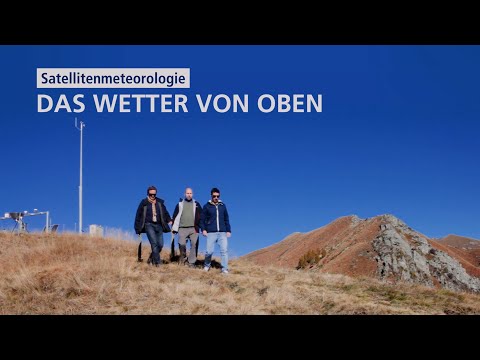
For the Federal Office of Meteorology and Climatology MeteoSwiss, satellite observations are an essential part of the weather observation system. In this film, MeteoSwiss experts explain the various aspects of weather satellites.
Committees & Boards
Memberships, representation and organisational roles.
- 2018–today
- Representative for SwitzerlandEUMETSAT Meteosat Third Generation (MTG) User Preparation Group.
- 2018–2024
- MemberSwiss Commission on Remote Sensing (SKF).
- 2010–2015
- Member of the scientific advisory committeeCGMS International Clouds Working Group (formerly Cloud Retrieval Evaluation Workshop, CREW).
- 2011, 2014
- Co-organiserCREW-3 (Madison, Wisconsin, USA, November 2011) and CREW-4 (Grainau, Germany, March 2014) workshops.
- 2004–2005
- Elected memberStudent parliament, Leibniz University of Hannover.
- 2000–2004
- Member of the student councilFaculty of Mathematics and Physics, Leibniz University of Hannover.
Curriculum vitae
Skills
- Scientific expertise
- Meteorology
- Remote sensing
- Satellite meteorology
- Thunderstorm nowcasting
- Decision support
- Radiative transfer
- Environmental science
- AI & data
- Artificial intelligence
- Machine learning
- Deep learning
- Data science
- Statistical data analysis
- Data management
- PyTorch
- TensorFlow
- MLflow
- Analytical skills
- Programming
- Python
- C
- Fortran
- IDL
- Matlab
- MPI
- git
- LaTeX
- HTML
- Computing & operations
- Scientific computing
- HPC
- Linux / Unix
- Containers
- Cloud computing (AWS)
- Terraform
- Software design
- Operations management
- Management & collaboration
- Project management
- Software project management
- Requirements engineering
- Product delivery and customer coordination
- Leadership
- Acquisition of research funding
- Teamwork
- Communication
- Languages
- German native
- English very good
- Italian good to very good
- French basic
- Dutch basic
Work experience
- 2026 – today
- Varda: AI weather prediction, MeteoSwissContributor to Varda, the data-driven weather prediction system of MeteoSwiss, design and planning of the use of satellite data and of thunderstorm nowcasting, temporal interpolator, and preparation of a EUMETSAT fellowship on MTG observations.
- 2025
- Change to the Development of Forecasting department in the Service and Development division, MeteoSwiss, Locarno-MontiDevelopment and operation of AI-based forecasting and nowcasting systems.
- 2020 – 2026
- Scientific project lead COALITION-4, MeteoSwissDeep learning nowcasting of lightning, hail and heavy precipitation, from model development to operational deployment in the Amazon Cloud (2025) and automatic thunderstorm warning suggestions for the MeteoSwiss App (2026); co-lead of the cloud migration.
- 2018 – 2023
- Scientific project lead COALITION-3, MeteoSwissMachine learning prediction of the severity of thunderstorm cells from radar, satellite, lightning and NWP data.
- 2014 – 2022
- Scientific project lead COALITION-2, MeteoSwissSatellite-based detection of developing thunderstorms with MSG/SEVIRI, complementing the radar-based thunderstorm tracking.
- 2013
- Start to work as research scientist, Radar, Satellite and Nowcasting department, MeteoSwiss, Locarno-MontiExpert for satellite remote sensing and thunderstorm nowcasting.
- 2010–2013
- EUMETSAT fellow, KNMI, De Bilt, NetherlandsComparison of cloud remote sensing algorithms; co-coordination of the CREW project.
- 2010
- Postdoc, DLR Oberpfaffenhofen, GermanyImplementation of the ice cloud optical property parameterisation of the climate model ECHAM in libRadtran.
- 2005–2010
- PhD student, DLR Oberpfaffenhofen / LMU MünchenThe radiative heating rate in the tropical tropopause region (grade: very good); software development for libRadtran.
Training and certifications
- 2025
- AWS Certified Cloud PractitionerAmazon Web Services.
- 2025
- Terraform trainingMeteoSwiss, Zurich.
- 2024
- Software Assurance Level (SWAL) trainingMeteoSwiss, Zurich.
- 2024
- Hands-on introduction to deep learning with PyTorchCSCS, Lugano.
- 2023
- MeteoSwiss Python courseTesting, CI/CD, containerisation, AWS.
- 2018
- Machine Learning Summer School 2018Universidad Autónoma de Madrid, Spain (all MLSS editions).
- 2015
- Supercomputers and containers for data scienceCSCS; Machine learning (Coursera); Python onsite course (python-kurs.eu).
- 2011
- Satellite image interpretation and applicationsEUMETCAL / EUMeTrain.
- 2008
- Advanced Atmospheric Training CourseESA, University of Oxford.
- 2005
- Cargèse International School on the UTLSCOST Action 723, Corsica, France.
Teaching
- 2003–2004
- Courses for school students, Leibniz University of Hannover (Gauß-AG)Two courses in astrophysics and one on glaciers and polar lights, each 10 × 2 h.
Education
- 2010
- Dr. rer. nat., Ludwig-Maximilians-Universität MünchenThesis carried out at the DLR Institute of Atmospheric Physics.
- 2003–2005
- Diploma in meteorology, Leibniz University of HannoverThesis: The development of the Monte-Carlo radiative transfer model PROMT (grade: very good).
- 2002–2003
- Arctic geophysics, University Centre in Svalbard (UNIS), NorwayRemote sensing, oceanography, polar meteorology, snow and ice processes, radar diagnostics of space plasma. Report with photos.
- 1998–2002
- Physics (Vordiplom, grade: very good) and meteorology, Leibniz University of Hannover